Session recording
Stop Building Models. Start Building Intelligence.
Carolina Lago, AFMFounder, Tactic Financial
Recording and slides free until 11:59 p.m. ET on Sunday, October 11
The free viewing window has closed.
The recording of Carolina’s session is included with FMI Foundations and the Advanced Financial Modeler (AFM) Program, along with every other session from the conference.
But Carolina’s session follow-up guide is free. Download below.
“This is brilliant, Carolina… Everyone should watch this.” Ian Schnoor, Executive Director, Financial Modeling Institute, during the 24-Hour Global Financial Modeling Conference
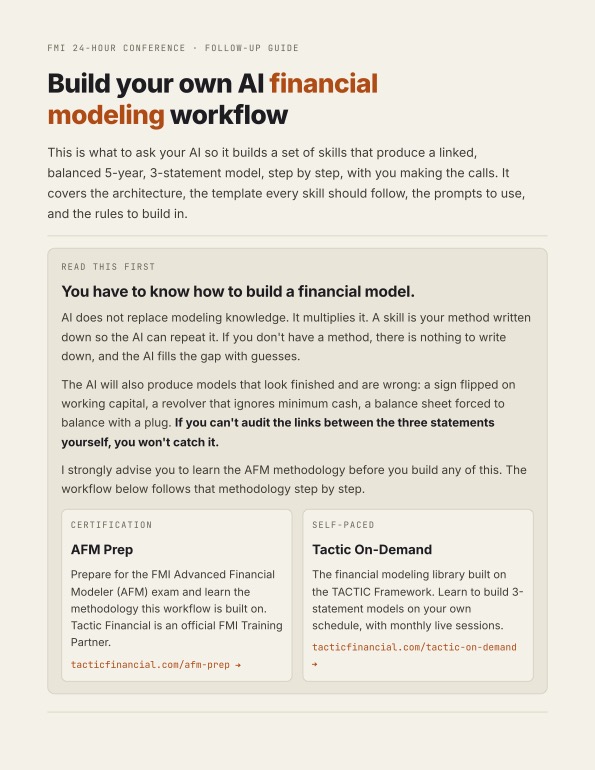
Build your own AI financial modeling workflow.
Learn what to ask your AI so it builds a linked, balanced 5-year, 3-statement model, step by step, with you making the calls.
- 1
Architecture
One skill per step and an orchestrator on top, in the order each schedule depends on.
- 2
Template
The six steps every schedule skill follows, from historical build to carry-forward.
- 3
Prompts
What to ask your AI, in order, from planning the pack to testing it on a practice case.
- 4
Rules
What to build into every skill: no invented historicals, no plugs, and you set the assumptions.
“AI does not replace modeling knowledge. It multiplies it.”
AI can build the model. You build the intelligence.
AI can build a financial model. Carolina’s thesis is this: AI works as a tool inside a disciplined modeling process, with the modeler directing every step, not as a replacement for the modeler.
Probabilistic
The intelligence AI brings. It guesses, and usually guesses well. When it is wrong, it looks exactly as confident as when it is right.
Deterministic
The rules you lock down: calculations, templates, code. Anything that has to be exact is never left for AI to guess.
Human judgment
Context no system holds, a check on the way through, and a name on the result at the end. The one force that gets better with every run.
Too much probabilistic and the model hallucinates. Too much deterministic and you have built a macro, not an AI workflow. And the modeler who tries to automate themselves out of the loop watches the results get worse, run after run.
One skill per step
One giant prompt that tries to produce a whole model does not work. Break the build into steps and give each its own skill: one job, the previous step's output as its input, and a checkpoint where it stops and asks you. When something breaks, you fix one skill, not the whole system.
Then go deeper
With the formulas handled, the time goes to interrogating the model. Which assumption breaks first? What would have to be true for this to be wrong? What does this model imply that you have never looked at? Ask AI to explain the business back to you from the numbers.
Early in the live run, the workflow stopped itself: cost of sales ran at 128% and 116% of revenue for two years, then fell to 62%. Nothing in the numbers explained the swing, so it asked. Carolina knew: the company was digesting an acquisition, and averaging those years would have dragged a broken margin into the forecast.
Later, a margin that climbed and then faded looked like a bug. Every check passed and the balance sheet balanced. It was the business hitting the capacity limit she had flagged at the start, and she told the model to keep it rather than smooth it away.
Worth passing on.
Each quote comes as an image for LinkedIn, dark or light, with the post already written. Pick one, download the image, and post it in three steps.
“You cannot orchestrate what you cannot understand.”
“AI doesn't change the process. AI changes who executes each step.”
“The skills build the model, and you build the intelligence.”
“The worst part, it's not that it's wrong. The worst part is that when it's wrong, it looks right.”
“AI is a tool. It's not here to replace me. It's here to be used by me.”
“You will never know how to command AI if you don't know how to do it.”
Carry the conference into your own work.
Two ways to carry the conference forward: learn how a model is put together, or prove you can build one from scratch. Both FMI programs include every conference video and the presentation materials.
FMI Foundations in Financial Modeling Program
Learn core financial modeling concepts at your own pace. Access all conference videos and presentation materials.
Advanced Financial Modeler (AFM) Program
AI can generate a model in seconds, but it can't tell you if the logic holds. The AFM proves you can build trusted financial models. Access learning resources and the full conference video library.
